


Choosing a joint venture’s operating model, meaning how independent the venture will be from its shareholders, is one of the trickiest decisions in JV dealmaking. It can’t be negotiated as a single deal term, it shifts economics between the owners, and the right answer changes as the venture matures.
This article introduces Ankura’s Operating Model Selection Tool, which is designed to open a structured conversation among owners, boards, and management teams.
Key takeaways include:
- The operating model is a bundle of choices, not a term. It combines contract terms, governance policies, and day-to-day behaviors, so neither dealmakers nor JV executives fully control it.
- In natural resources, mixed operatorship models have spread as energy and mining companies move into adjacent sectors.
- A handful of factors, including equity stake, regulation, capabilities, and project lifecycle, often point to one best-fit model.
- Surveying owners before the discussion often reveals divergent views, which is a strong case for clarifying the model – and understanding disagreement is a useful output in itself.
How do you choose the right operating model for a joint venture? Ankura has worked with dozens of companies, JV boards, and management teams to evaluate the options. We have found that this choice – how independent the venture will be from its shareholders in terms of assets, people, processes, systems, services, products, and culture – is surprisingly tricky to get right.
Three things make it difficult.
First, the operating model is not a single deal term. It cannot be negotiated in isolation because it is a combination of terms, decisions, and behaviors. Some are embedded in the contractual agreements; others are found in the venture’s governance and operating policies and practices. Neither dealmakers nor JV executives fully control the operating model.
Second, the choice moves real money. The operating model has substantial impact on individual shareholder economics and strategy, which makes the decision prone to commercial conflict, concealed interests, and politicized negotiation.
Third, the right answer changes. Operating models are dynamic. They often need to evolve as the venture moves from project to operations, as markets or shareholder strategies shift, or as venture management teams – having proven themselves capable of running the business – press for more independence.
A look across industries at some of the world’s largest joint ventures shows how regularly the operating model gets adjusted. In the last few years alone, we have worked with:
- A chemicals JV that shifted from having an independent management team to being closer to the parents, with the venture led by secondees
- A mining joint venture in which the partners fundamentally changed the services agreement between the JV and one of its owners
- A fuel retail joint venture where the partners brought in a third-party operator to replace the original operating shareholder
Ankura’s Joint Ventures & Partnerships Practice has developed a range of resources to help companies diagnose, design, and implement new operating models in joint ventures. The purpose of this note is narrower: to introduce a simple tool we use to start the conversation.
An Operating Model Selection Tool for Natural Resources JVs
Companies in natural resources and adjacent sectors – including oil and gas, metals and mining, and chemicals – have historically favored single-partner operated models, in which one company operates the venture on behalf of the other participants, and the powers, liabilities, rights, and obligations of the operator and non-operators are clearly defined in industry model-form agreements. For decades, this meant the choice of operating model came down to a simple question: do we operate the venture, or does one of our partners?
That question has become considerably more complicated. Many of the largest projects are now structured under a “mixed-operator” model – which, in practice, is not one model but a family of models in which the partners work in an interdependent way. Mixed operatorship has become ever more prevalent as traditional energy and mining companies have expanded into adjacent businesses, including low-carbon hydrogen, sustainable aviation fuel, batteries, data centers, and other partnerships involving diverse types of owners.
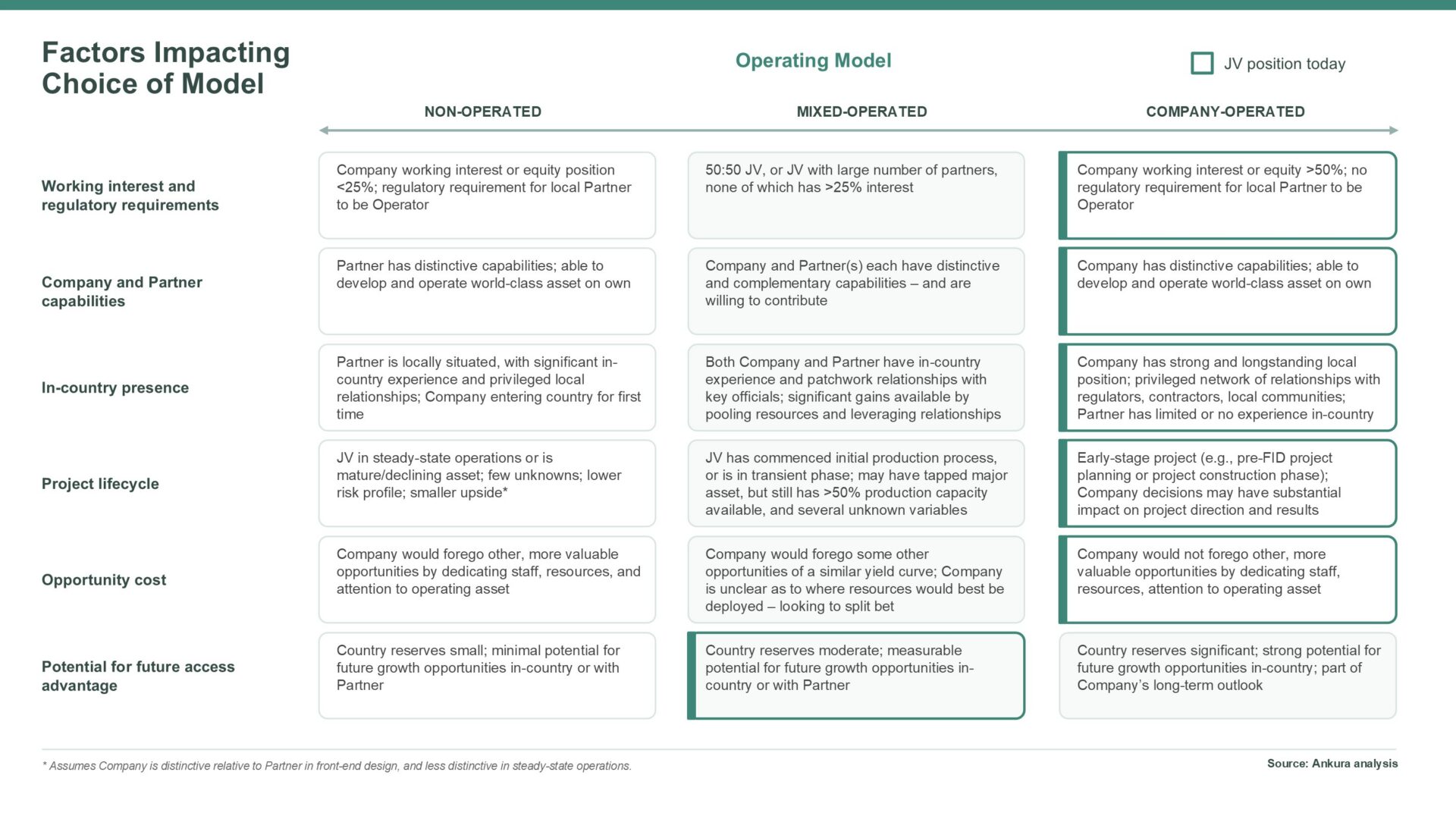
Selecting an operating model ultimately requires much deeper analysis. But to start the conversation, we have found it powerful to use a simple instrument we call the Operating Model Selection Tool (Exhibit 1). Across the top are three basic choices: non-operated, mixed-operated, and company-operated. Down the side are the factors that inform which is the most natural fit.
Exhibit 1: Operating Model Selection Tool – Natural Resources JVs
© Ankura. All Rights Reserved.
Consider the first factor: working interest and regulatory requirements. On the left of the spectrum, companies are more likely to choose non-operatorship when their working interest or equity position falls below 25%, or if the local regulatory regime requires a local partner to maintain operational control over domestic assets. Moving right, a company would be inclined toward mixed operatorship for bilateral 50:50 ventures, or for multilateral JVs in which no partner holds a dominant share.
Having worked down the list, dealmakers should step back and ask which factors are most salient to the situation at hand. In our experience, teams usually find that many factors have clustered around one model in particular – and that working through disagreements that surface along the way is as useful as the conclusion.
The tool is not a stand-alone exercise. It should be paired with other analyses, such as a review of case profiles of operating models used in the industry, or a comparative assessment of the candidate models in terms of value creation, risk, manageability, and feasibility of adoption.
| Related insight: “Developing JV Deal Options” outlines a five-step process for building and evaluating alternative deal structures, including the JV’s scope, contributions, and governance, before negotiations harden around a single option. |
An Operating Model Selection Tool for Shared Utility JVs
Companies form all sorts of joint venture structures. One is the shared utility – a venture formed among multiple industry peers who serve simultaneously as its owners and its customers. The structure is common in banking, healthcare, travel and transport, and other industries characterized by rapid technology change, or where a large number of players operate under severe cost pressure.
In banking, companies have long used utility JVs to reduce costs and improve future technology returns by consolidating IT and other back-office functions, or to co-invest in next-generation technologies and services that support core operations. Increasingly, that includes shared cloud infrastructure or data center capacity that no single owner could justify building alone. Similar stories can be told in payments, airline and travel technology, and parts of the US healthcare sector, where health systems have pooled clinical data, collaborated on revenue cycle management platforms, and jointly secured drug supply.
Getting the operating model right in these ventures, and keeping it right as the venture and its market evolve, is tricky. Utility ventures are usually designed at formation to capture cost savings from economies of scale and pass those gains to their owners through reduced pricing and shared investment. Over time, as the original mission is realized and market dynamics create new growth opportunities, that construct comes under severe pressure. Our work suggests that five to ten years after formation, such ventures often need an operating model adjustment. Shareholders must decide whether to grant greater independence to JV management, and whether to inject more market-based characteristics into pricing, investment decisions, and customer interactions – the last of which becomes highly complex and invasive when the customers are also the owners.
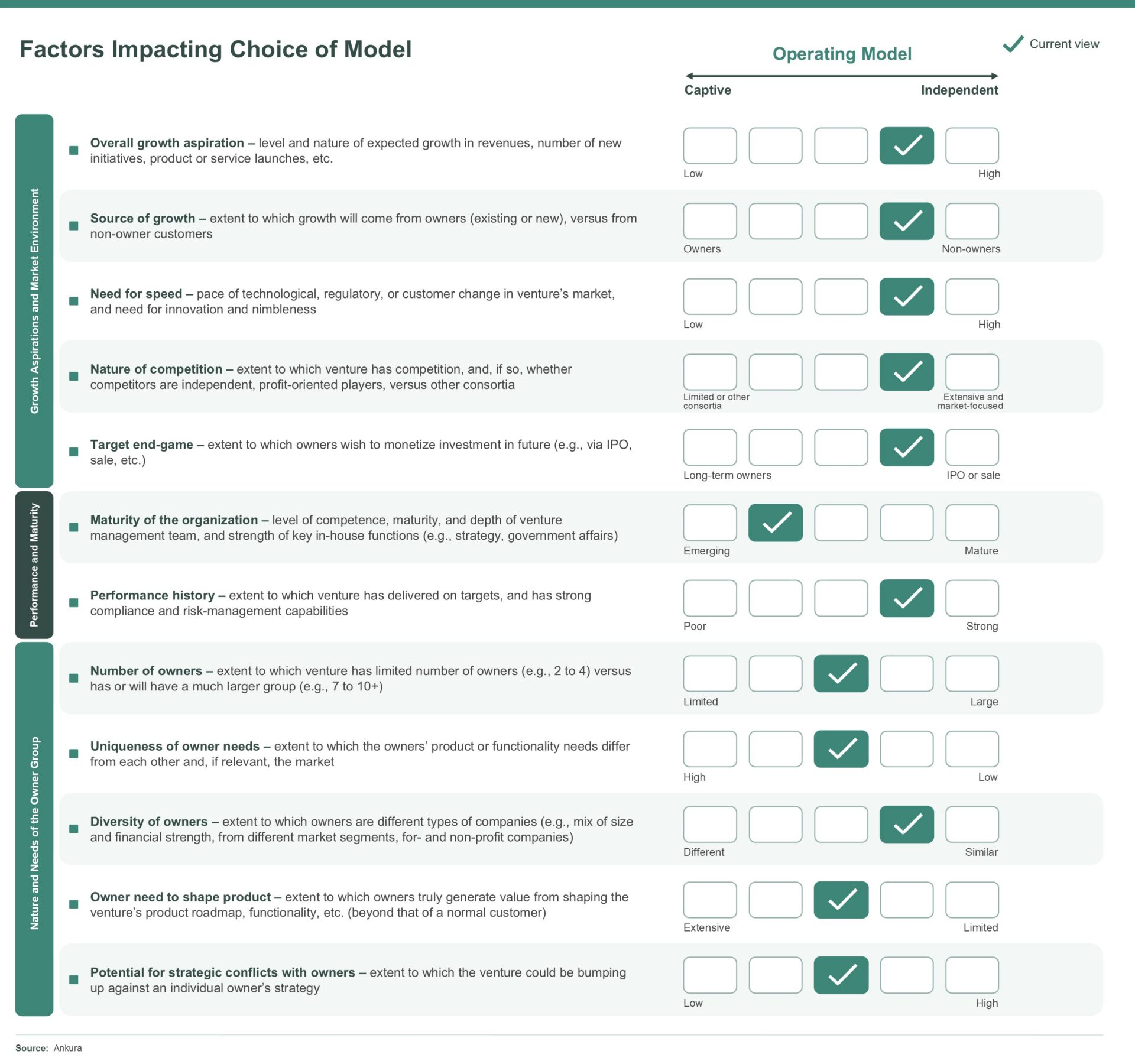
To help owners, boards, and management teams of these ventures choose the right model, we use a different version of the Operating Model Selection Tool (Exhibit 2). It is built the same way as the natural resources version: the range of operating models is arrayed as a continuum across the top, with the key factors shaping the choice running down the side. For utility ventures we define five basic choices, ranging from captive at one end to independent at the other, with three intermediate positions in between. A dozen common factors inform where a venture should sit.
Some factors relate to growth aspirations and the market environment. Does the venture aspire to grow significantly over the next three to five years by adding new customers or services, or is the ambition more modest? Will growth come from the existing owner-customers, or will it need to come from non-owner customers? And against whom is the venture competing – other shared-utility JVs, or independent, profit-oriented players?
The answers shape the choice of operating model. When a venture has high growth aspirations and much of that growth is likely to come from non-owner customers, more independence is usually needed to capture the opportunity: market-based pricing, less invasive customer input into the product and technology roadmap, and greater delegation of authority to JV management.
Other factors relate to maturity and performance history. Ventures that are young, or that have underperformed on delivering core operational services to their owners, rarely give their owners sufficient confidence that more independence is justified.
Exhibit 2: Operating Model Selection Tool – Utility JVs
© Ankura. All Rights Reserved.
As with the natural resources version, this tool works best as a conversation starter among owner executives. It can be introduced at a JV board meeting or strategy retreat as a simple checklist to orchestrate a discussion about the venture’s future direction. In some cases, ahead of those conversations, we have asked board members and others in the owner companies to complete a short survey capturing their views on the key operating model questions, including the optimal model given future owner and market needs. The results often reveal meaningful divergence among the owners, which is itself a powerful case for clarifying and updating the model.
Choosing the right operating model does not have to be a chore. With a structured approach, dealmakers and operating executives alike can dimension the natural choice of model — and re-evaluate that choice as conditions change. Leave the ill-defined operating models behind, and choose wisely, for all the right reasons.
© Copyright 2026. The views expressed herein are those of the author(s) and not necessarily the views of Ankura Consulting Group, LLC, its management, its subsidiaries, its affiliates, or its other professionals. Ankura is not a law firm and cannot provide legal advice.
Comments